



Every six months, the same pattern repeats itself across organizations running Workday:
the bi-annual update announcement triggers a cascade of testing activities, late nights, and crossed fingers.
Yet despite the effort, critical issues still slip through to production, creating a costly cycle that most organizations dramatically underestimate.
The reality? Between emergency fixes, lost productivity, rework, and reputation damage, organizations face substantial hidden costs that compound with each update cycle.
Industry research reveals that the economics of manual testing are far more expensive than most finance and HR leaders realize.
The Exponential Cost of Finding Bugs Late
According to IBM’s Systems Sciences Institute, the cost to fix an error found after product release is four to five times as much as one uncovered during design, and up to 100 times more than one identified during maintenance. When critical issues slip through to production in your Workday system, you’re not just fixing a bug—you’re paying the exponential penalty of late detection.The Production Bug Premium
Research shows that bugs found in production cost 30 times more to fix than those caught early in development. For enterprise systems like Workday, where defects can affect payroll, benefits, and compliance, this multiplier effect is even more severe. Sources: VentureBeat, World Quality Report 2022-2023, IBM Systems Sciences Institute, Tricentis, Functionize Research (2025)Where Manual Testing Costs Hide
The true financial impact of manual Workday testing extends far beyond your testing team’s salaries. Consider these industry-verified cost factors:| Cost Category | Impact Factor | Industry Data |
|---|---|---|
| Developer Time on Bug Fixes | 20% of total time | ~€20,000/year per developer |
| Script Maintenance | 30-50% of testing resources | Up to 50% of automation budget |
| Emergency Production Fixes | 4-5x normal fix cost | Up to 100x if post-release |
| Manual Testing Inefficiency | 65% increase vs. automation | Time and cost per Tricentis |
The Automation Advantage: Real Numbers
Organizations that have implemented test automation for their enterprise systems see consistent, measurable improvements. According to a Capgemini survey of automation implementations: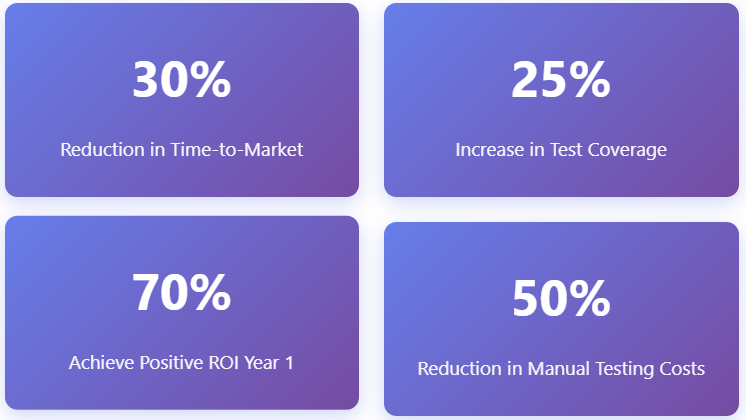
The 65% Efficiency Gap (Industry Benchmarks)
Testing Cycle Time
Annual Cost Impact
Test Coverage
Time Efficiency
Manual Testing
Automated Testing
The 65% Efficiency Gap
Tricentis research reveals a striking finding: organizations relying solely on manual testing experience an average 65% increase in both time and costs compared to those using automation. For Workday’s bi-annual update cycle, this efficiency gap compounds rapidly. Consider the math: If your manual testing cycle takes six weeks and costs €50,000 per update, you’re spending €100,000 annually just on the testing effort itself. With automation, that same coverage could be achieved in 8–10 days at a fraction of the cost—and with better results.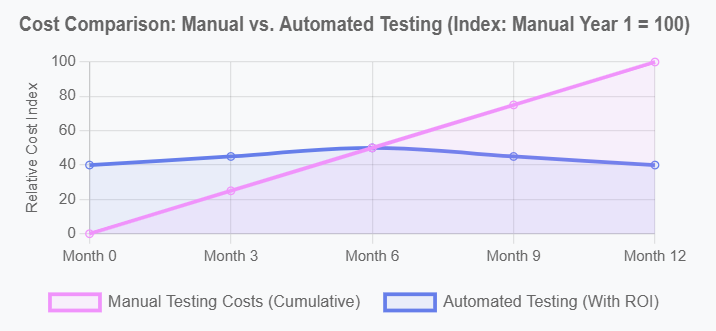
Investment Reality: What Automation Actually Costs
Let’s address the elephant in the room: automation requires upfront investment. Industry data shows typical costs include:- Tool Licenses: €3,000–5,000 per license annually for commercial tools (open-source options available)
- Infrastructure Setup: €10,000–50,000 depending on scale and complexity
- Personnel/Training: €1,000–5,000 per employee for upskilling existing staff
- Ongoing Maintenance: 10–20% of license costs for technical support
Meet ilumn: Purpose-Built for Workday Testing
While industry data proves the ROI of test automation, the real challenge is finding a solution purpose-built for Workday’s unique architecture and bi-annual update cycle. That’s where ilumn comes in. ilumn is LogicaCloud’s intelligent test automation platform designed specifically for Workday environments. Unlike generic testing tools that require extensive customization, ilumn delivers: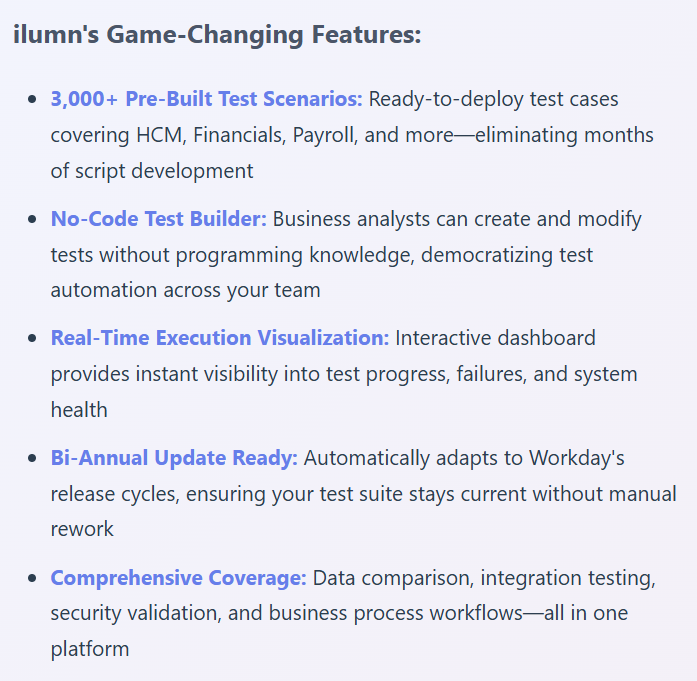
The result? Organizations using ilumn typically achieve test automation coverage of 85%+ within 6–8 weeks—compared to 6+ months with traditional automation approaches.
And because ilumn is Workday-native, you avoid the 30–50% maintenance overhead that plagues generic automation tools.
